In our survey of the solar system, we have discussed the majority of the largest objects that orbit the Sun. The Sun contains >99% of the mass of the solar system, and the planets make up the rest. We will talk about the Sun in our next class. Today we want to finish our survey by looking at the smallest objects in orbit around the Sun: Pluto (and other icy planetoids), comets, asteroids, and the dust and other small particles that are the remanants of comets and of asteroid collisions.
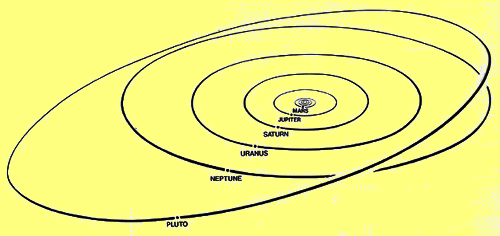
Pluto never gets very close to Neptune due to the inclination of its orbit carrying it above or below that of Neptune. In recent years there has been a raging debate to change the status of Pluto from that of a planet to that of an asteroid (more technically a "Kuiper belt object") as other members of this family were discovered that were bigger than Pluto! Pluto is very small, only 2,200 km in diameter, smaller than seven of the moons in the solar system. The average distance of Pluto from the Sun is 39.5 AU (5.9 billion km), and it rotates once every 6.3 days. Pluto has a small moon named Charon that orbits it once every 6.3 days (the rotation of Pluto is locked to the orbital period of Charon). These two objects are shown in the HST photo below:
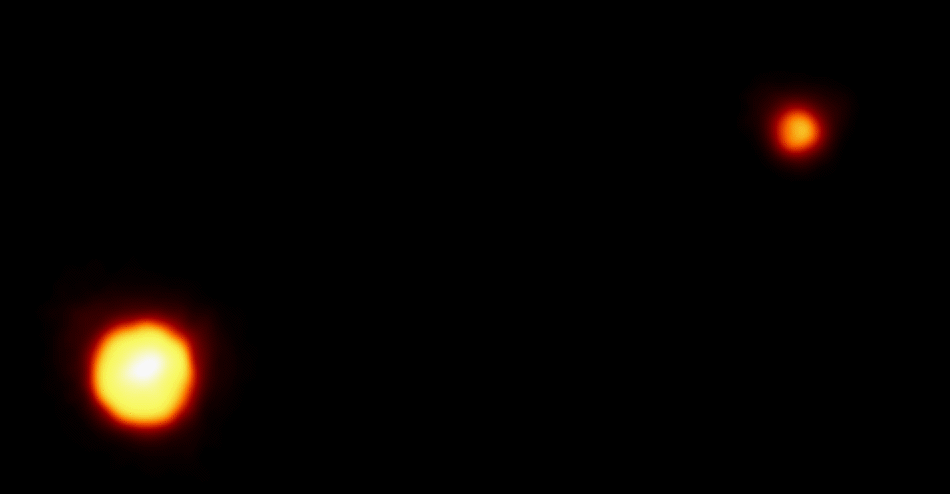
Pluto is too far way and too small to actually see very much surface detail from Earth. Using the HST, and by measuring its light curve, and using eclipses by Charon, we know that Pluto has a surface with light and dark patches:
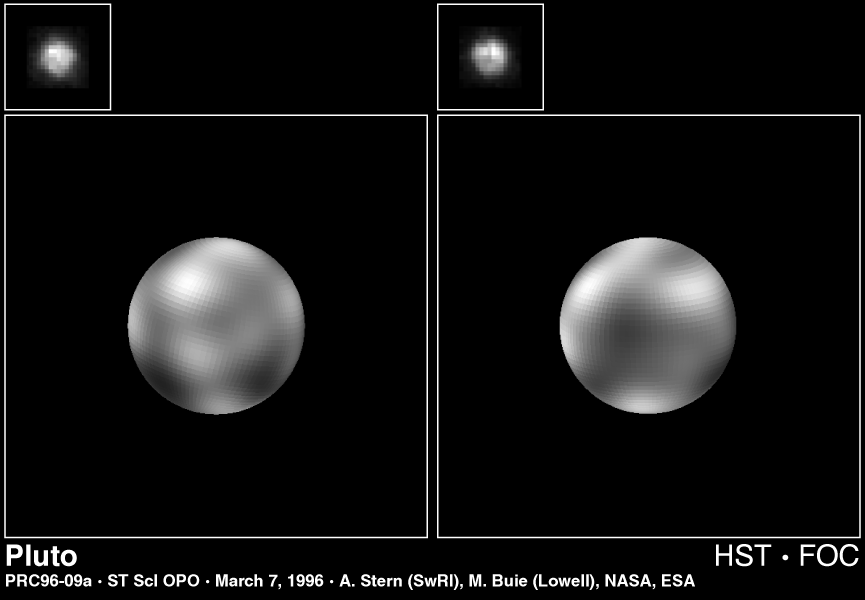
Recently, it has been shown that these features are changing over time! Pluto's tenuous atmosphere seems to have some sort of activity:
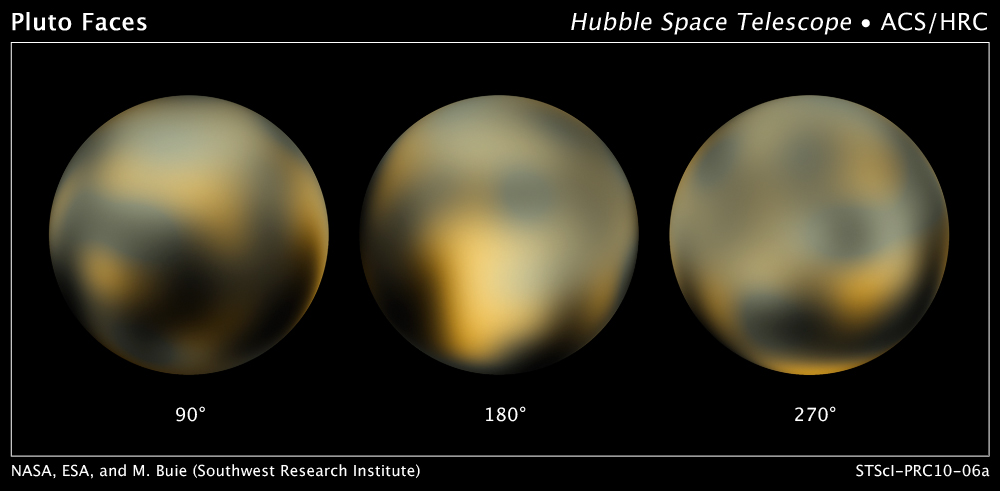
Pluto also seems to have a tenuous nitrogen atmosphere like that of Triton, but we know very little about Pluto. NASA has sent a mission, "New Horizons", to Pluto, but that probe will not reach there until 2015.
NMSU has very strong links to Pluto, as the discoverer of Pluto (Clyde Tombaugh) was a faculty member in the Astronomy department at NMSU for about 40 years. After the successful prediction and discovery of Neptune (using the "perturbations" in the orbit of Uranus), a large number of predictions arose about a possible planet, or planets, beyond the orbit of Neptune. Searches were begun to attempt to discover these bodies. Percival Lowell, an independently wealthy New Englander who was famous for his observations of the "canals" on Mars and his writings that speculated about intelligent life there, had build an observatory near Flagstaff, Arizona to study the planets. He soon became interested in searching for this 9th planet. Lowell began his search in 1913, and continued through 1915. Nothing was found, and Lowell died shortly after (1916).
A new search was begun at the Lowell observatories in 1927 without much success. At the end of 1929 a Kansas farmboy that was a practicing amateur astronomer (he had built his own telescopes), was hired at Lowell to continue the search. Two months later (18 February 1930), after examining a pair of photographs take on January 23rd and 29th, Tombaugh found Planet X by finding an object that had moved in the six days between photos. It was soon realized that this object was much too small to have been the planet Lowell had been searching for--it was clearly much smaller than the Earth. When Pluto's moon Charon was discovered, we could finally estimate its mass: 0.002 that of Earth! Pluto is indeed a rather insignicant object.
We now know the approximate size and density of Pluto. It has an equatorial radius of 1,137 km (0.18 times that of Earth), and a mean density of 2.0 gm/cm3. Pluto must contain quite a bit of rock mixed in with the water and other ices. Pluto's surface appears to be covered with methane ("natural gas", CH4) ice that evaporates during perihelion contributing to the very thin nitrogen atmosphere. In many ways, Pluto resembles Neptune's large moon Triton. The outer solar system contains more objects like Pluto (such as UB313 which is larger than Pluto!) and we will talk about these "Kuiper belt" objects in the comet section.
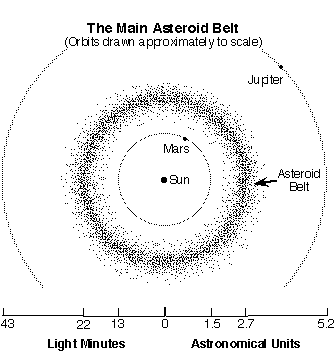
With the discovery of Uranus by Herschel, it was realized that there might be more planets out there. In fact, using a mathematical formula, Johann Bode had made a prediction in 1772 that there should be a planet between Mars and Jupiter. This prompted astronomers to begin to search for this missing planet. On January 1st, 1801 an Italian name Piazzi discovered an object that had an orbit of the right size. It was quickly realized that this object had to be very small to be so faint: less than 400 km in radius. This certainly was not a major planet, so it was called a "minor" planet, and given the name Ceres. Within a few years several more of these objects were discovered, and by the end of the 19th century more than 300 of these objects, now called "asteroids" were discovered! Most of these objects are arranged in a belt (the "asteroid belt") between the orbits of Mars and Jupiter (see figure 13.3 of the text) centered at about 2.5AU:
It has been estimated that there are probably one million asteroids as large as 1 km in the asteroid belt. So, what do asteroids look like? Mostly just chunks of rock, here is an image of the asteroid Ida:
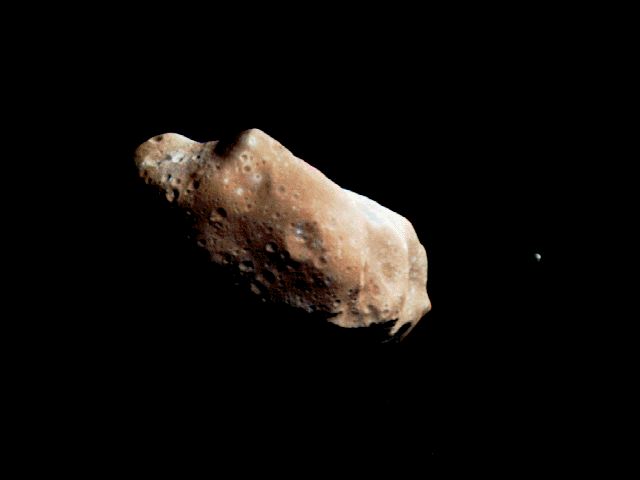
Ida is about 58 x 23 km in size. Suprisingly, Ida has a tiny little moon in orbit around (the speck in the above photograph to the right of Ida) that has been named "Dactyl":
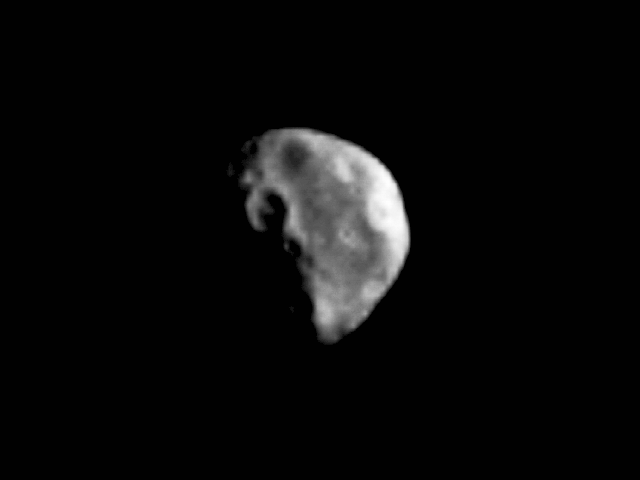
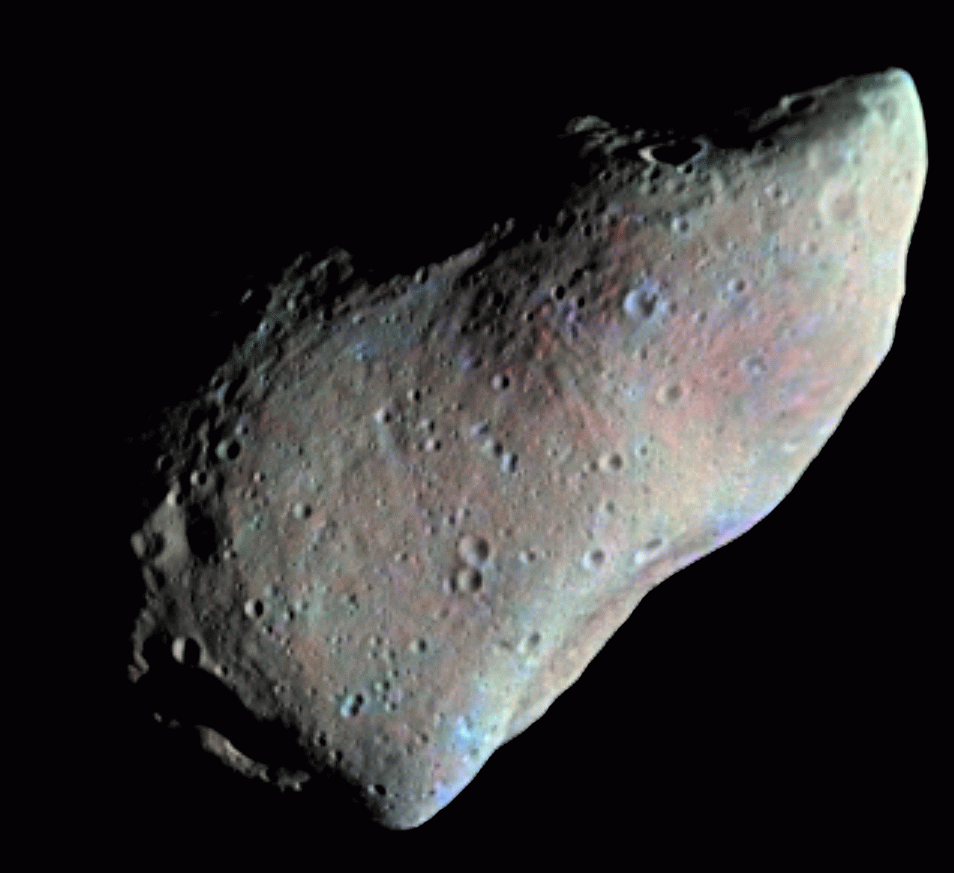
Dactyl is only about 1 km in diameter! On its way to Jupiter the Galileo spacecraft visited another asteroid named Gaspra and sent back this photo showing an abundance of impact craters:
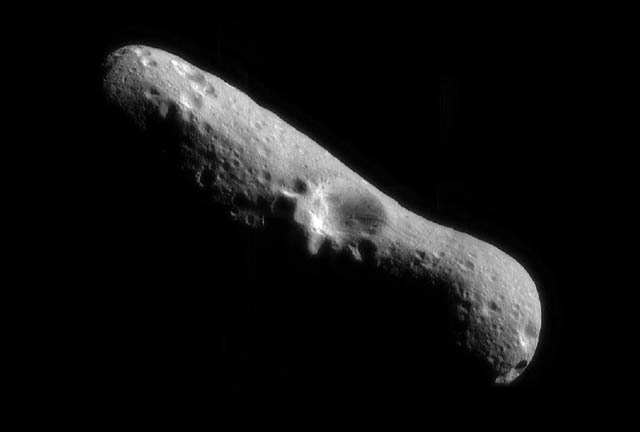
The typical asteroid has a density near 2.7 gm/cm3, so less dense than Mars. Except for the largest ones, asteroids do not have sufficient mass to force a spherical shape, in fact some of them are quite elongated like Eros:
The mass of all of the asteroids in the belt is estimated to be 1/500th that of the Earth. Asteroids are left-over material from the formation of the solar system. Due to interactions of the asteroids with the gravitational pull of the planets, and due to collisions among the asteroids, many objects are ejected out of the asteroid belt and end-up on very elliptical orbits like that for Icarus:
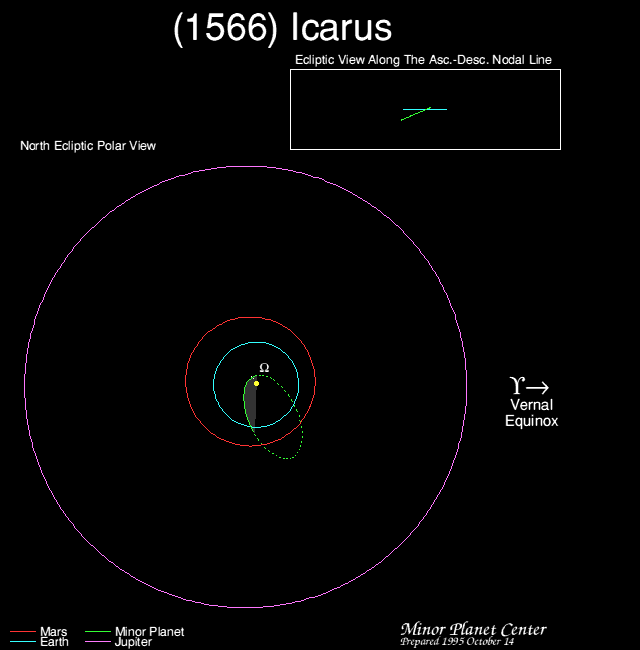
The orbit of Icarus carries it inside the orbit of Mercury at perihelion, and beyond Mars at aphelion! Fortunately for the Earth, the orbit of Icarus is tilted so that a collision is not likely (as demonstrated by the small box in the upper right hand corner of this plot). This is not the case for other asteroids--there are hundreds of them out there that could someday collide with the Earth. There are a number of programs to try to find these objects to insure that we will have some sort of warning before they collide with the Earth and blast a impact crater that could wipe out millions of lives. It is now believed that the impact of an asteroid-sized object with the Earth 200 million years ago killed-off the dinosaurs. As we discuss below, the Earth is constantly being bombarded by such debris--most of it harmless.
While asteroids were not discovered until 200 years ago, comets have been known since antiquity. Comets were known to all of the ancient peoples, and for most, they were a fearsome sight---as they were considered bad luck (in fact, the word disaster comes from the Latin for "Evil Star", often used in reference to comets). It was not until Tycho showed that comets were outside of the Earth's atmosphere did we begin to understand their true nature. Comets can be the most spectacular objects in the nighttime sky:
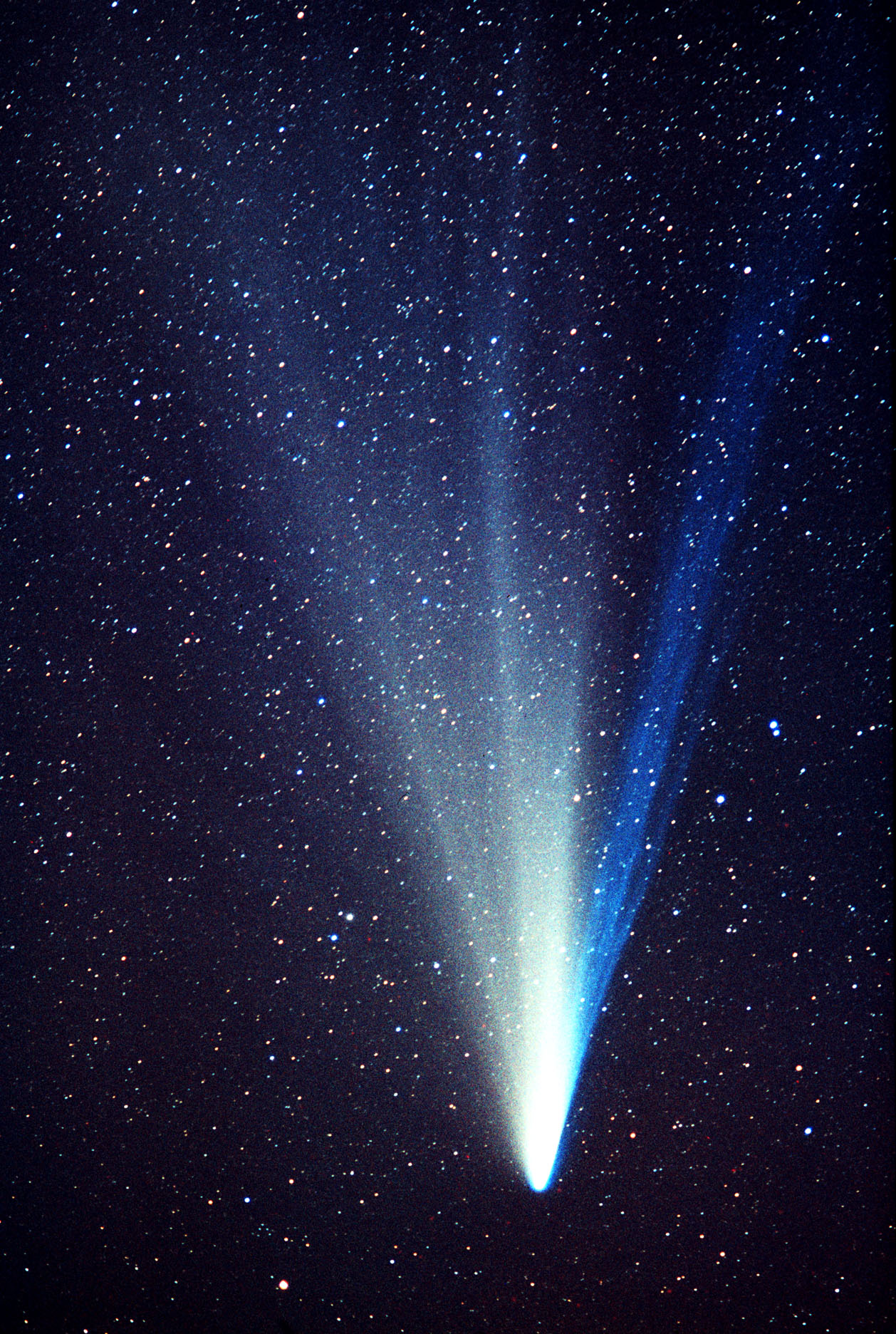
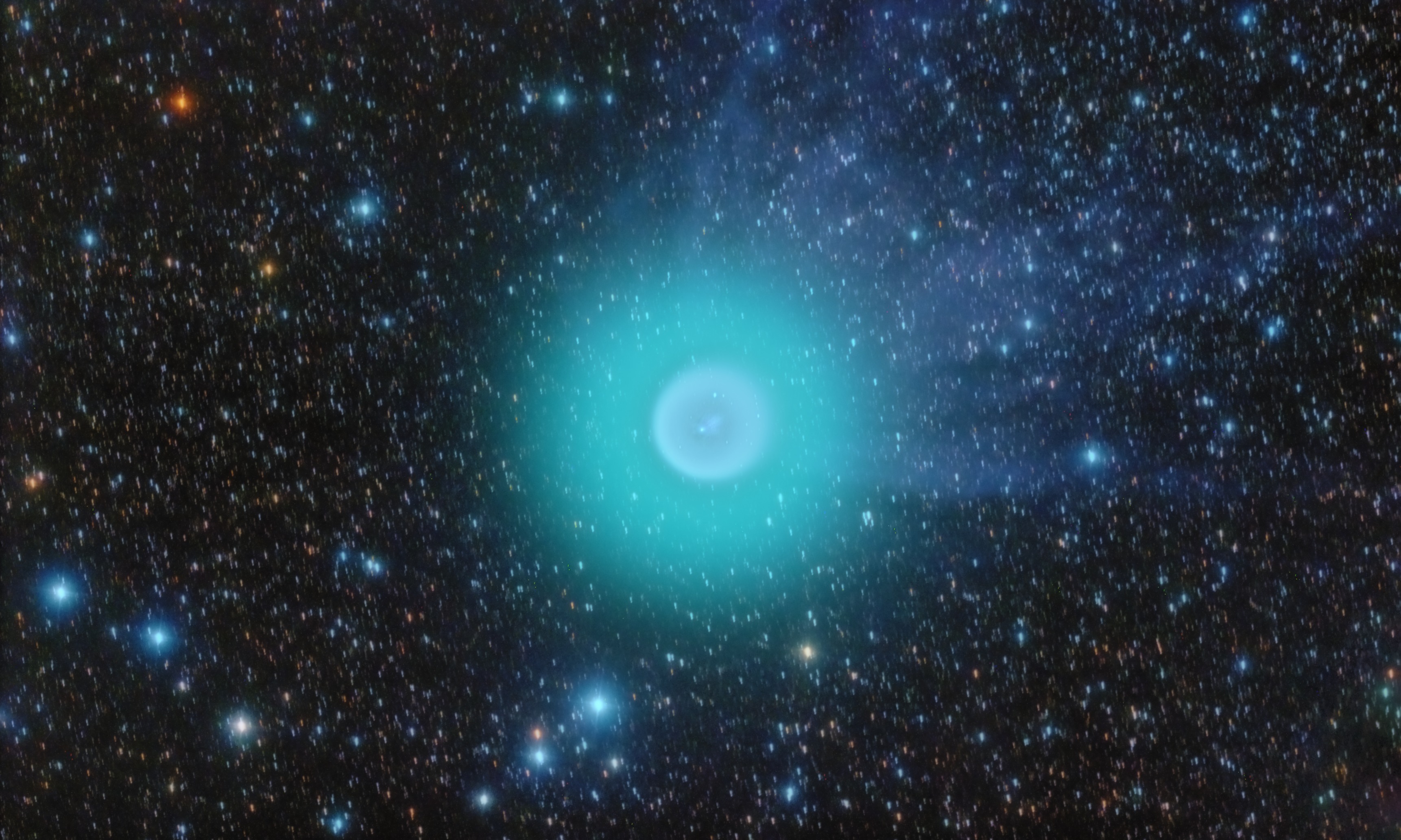
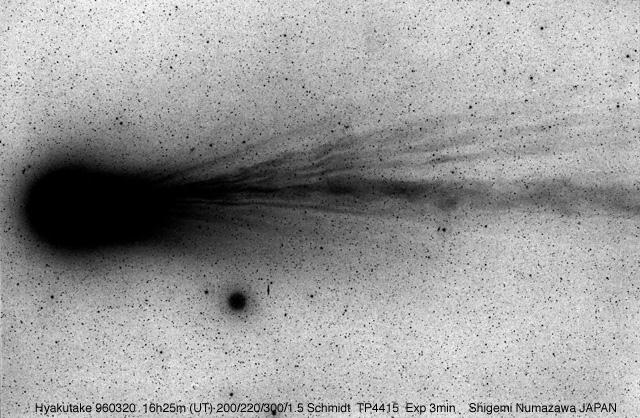
As you can see in these photographs, comets have quite a bit of structure. There are several main parts to a comet: the nucleus, the coma, and the tail:
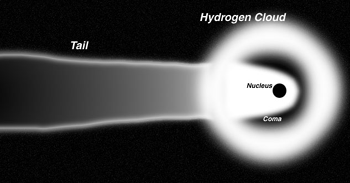
There are also two types of tails seen on most comets, a yellowish dust tail, and a bluish "ion" tail:
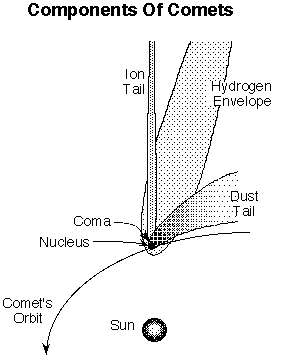
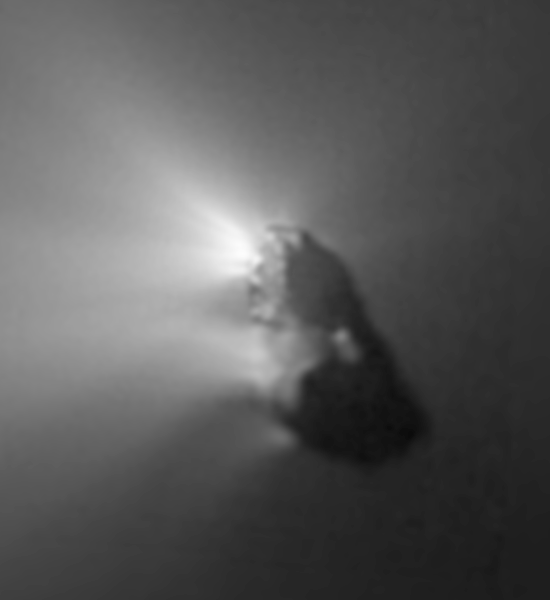
The ion tail always points directly away from the Sun. It is made up of charged atoms (such as hydrogen, oxygen, nitrogen) and some molecules. The light from the Sun exerts a pressure on the gas from the comet, pushing it out in a radial direction. The dust tail, however, is usually curved. The dust particles are larger than the gaseous particles, and thus do not respond to the sunlight in quite the same way--the particles go into orbit around the Sun, generally following in the comet's orbit. At the heart of a comet sits the nucleus, a dirty snowball of frozen gases, ices, dust and rock:
In July of 2005 we sent a mission, "Deep Impact" to probe a comet's nucleus by smashing a large projectile into it, here is a mosaic of the impact:
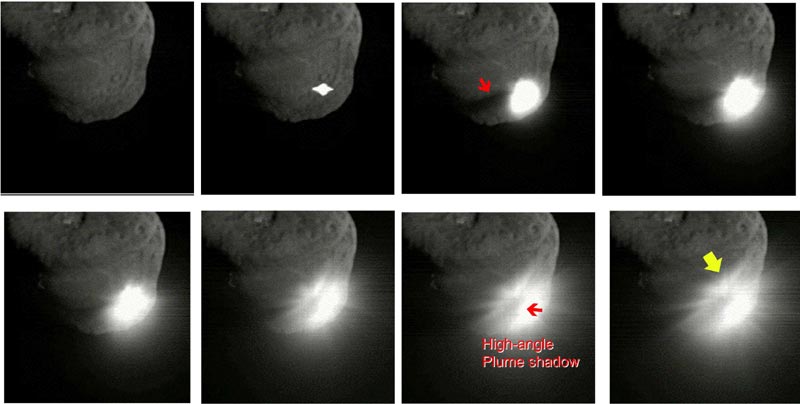
An animation of the encounter.
The material that forms the coma and tail appears to be spewed out of cracks in the surface of the comet. The heating from sunlight is what drives these geyser-like features. The nuclei of comets range in size from about 1 km up to 100 km in diameter. Comets are mostly ice, and spend most of their life far from the Sun (or else they'd melt!). Comets have the most extreme orbits of any solar system objects:
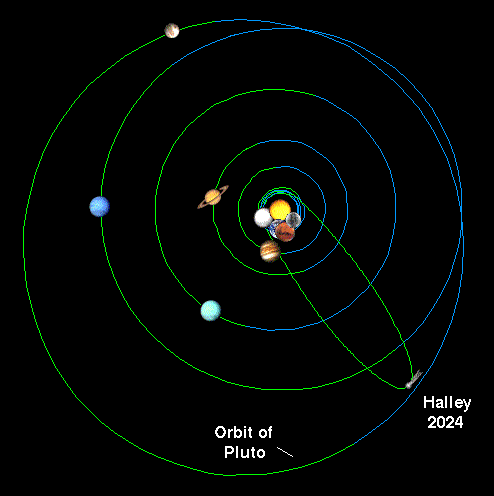
The orbit of Halley's comet (shown above), for example, has its perihelion at 0.587 AU (inside the orbit of Venus), and its aphelion at 39AU--out by Pluto! Halley's comet takes 76 years to complete one orbit of the Sun. Because it regularly appears, Halley's comet is known as a "periodic" comet. Periodic comets are ones that have orbital periods that are relatively short, less than 200 years or so. Most comets, however, have extremely eccentric orbits, and can have periods of millions of years! Most of the time the comet is cold, and invisible. As it approaches the Sun, however, the ices begin to vaporize and form the structure we see (see figure 13.12 of the text):
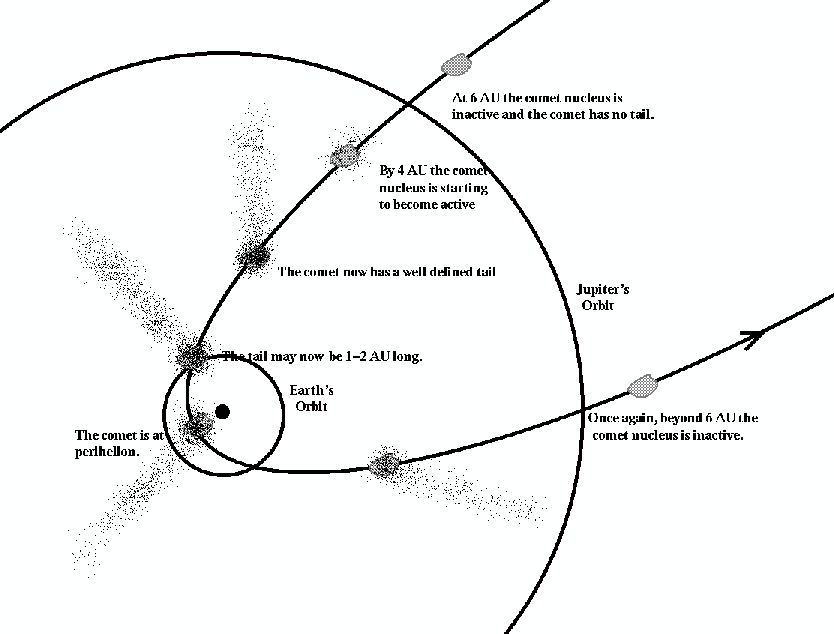
Where do comets come from? Periodic comets like Halley probably started life much futher out in the solar system than where it is now. On one of its trips inwards, it passed close to a planet (probably Jupiter) which changed its orbit so that it now spends its life much closer to the Sun. By carefully examining the orbits of hundreds of comets, we now believe there are two large "resevoirs" of comets, the "Kuiper belt", and the "Oort cloud". The Kuiper belt resembles the asteroid belt, except that it is much further out: 30 to 100 AU:
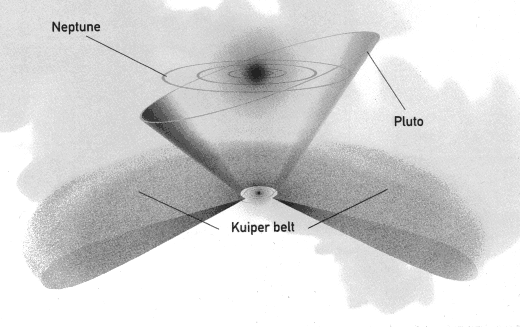
Astronomers have discovered about 400 objects in the Kuiper belt, and there are probably are about 100,000 objects in total. Both Pluto and Neptune's moon Triton might be examples of large Kuiper belt objects. A number of objects nearly as big, or bigger than Pluto have been found out in the Kuiper belt.
The long period comets probably come from the Oort cloud. While the Kuiper belt is believed to be a fairly flat disk-like region, the Oort cloud is expected to be spherical, and surrounds the entire solar system. The Oort cloud is enormous, up to 50,000 AU in radius:
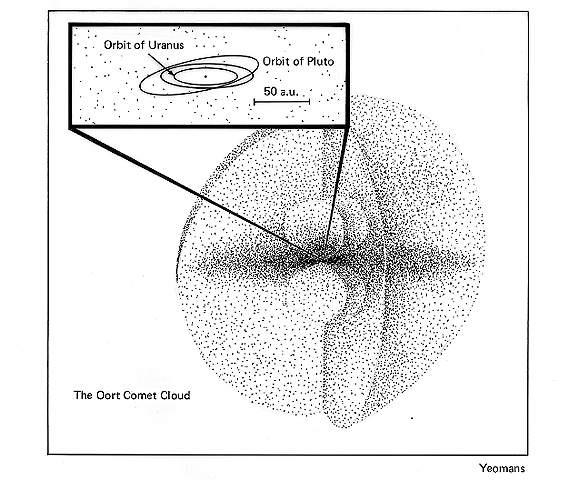
Interactions among the objects in the Oort cloud, as well as with other stars in our galaxy, probably are responsible for sending these objects on their course for an encounter with the Sun. Astronomers are interested in comets, as they represent the most pristine material of the solar system, in that they formed far from the Sun, and keep a frozen record of the composition of the early solar system. Because they rarely come close to the Sun, the remain relatively unaltered. By analyzing comets, we hope to unlock some of the mysteries of the early solar system.
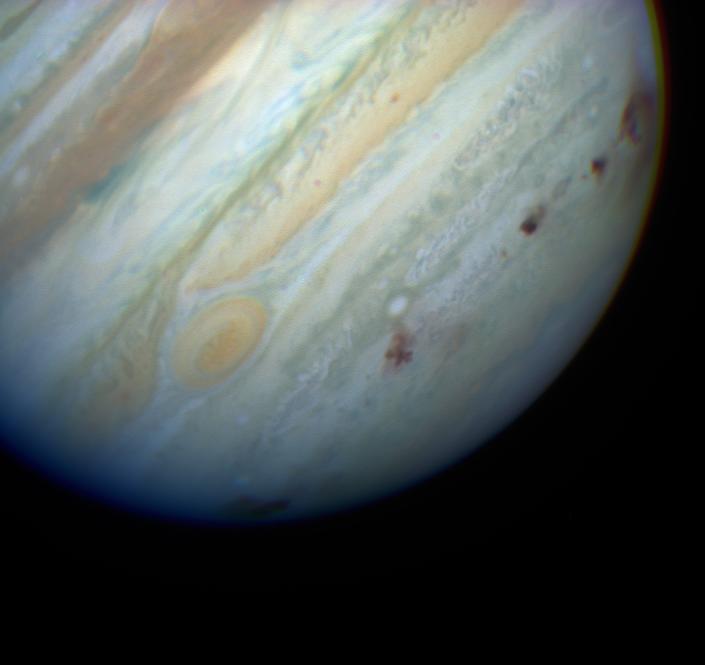
Comet destruction: the interaction of comets with other objects eventually lead comets to plunge into other objects in the solar system. Most of these end up crashing into the Sun--here is a movie showing two comets that got too close to the Sun. Comets also crash into planets, here is an animation of an impact on Jupiter of one of the fragments, and here is a picture showing the impact sites of several of the pieces of this comet:
Recently, it was announced that an object larger than Pluto had been discovered in the Kuiper belt. This object has the odd name 2003 UB313. Over the last few years evidence has been mounting that there are a number of objects similar to Pluto in the Kuiper belt, but until the discovery of UB313, all of them had been smaller than Pluto. Now we have an object bigger than Pluto, and the argument is whether we should call this object the 10th planet. Some would argue that we should demote Pluto from a planet to merely a Kuiper belt object. A decision was made to demote Pluto and add UB313 into the family of "dwarf planets". There are a few other members, and more will probably be found. Here is a comparison of the orbit of UB313 to the other planets in the outer solar system:
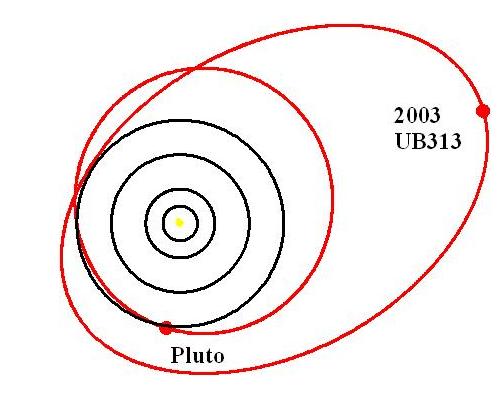
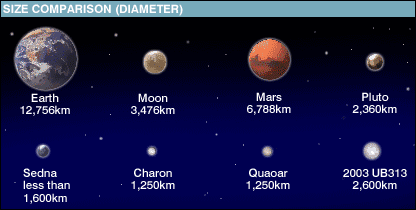
UB313 takes 560 years to orbit the Sun! Its orbit is very eccentric, sometimes it is as close as Pluto (perihelion occurs at 38 AU), while sometimes it is twice as far away (aphelion occurs at 97 AU). Here is a comparison of UB313 to Pluto and a few other Kuiper belt objects:
What is UB313 like? A spectrum shows that it is quite similar to Pluto:
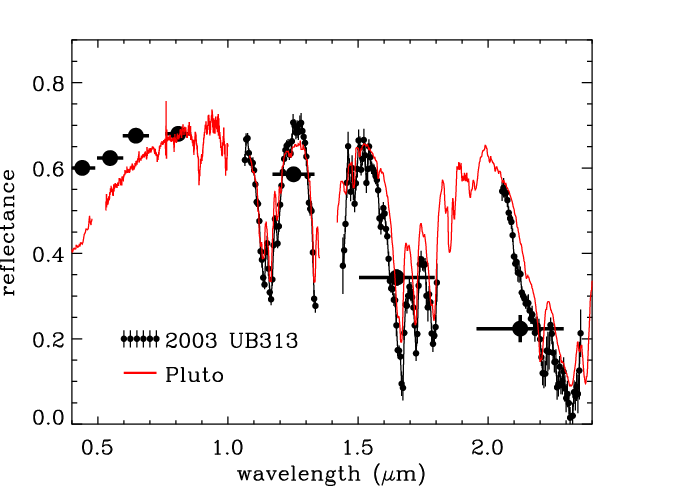
Obviously, whatever we call Pluto, UB313 deserves a similar classification.
Meteors are closely related to both comets and asteroids--they are in fact, probably tiny pieces of comets and asteroids! What is a meteor? On any clear night, sitting in a dark sky, you will occasionally see a fast streak of light:
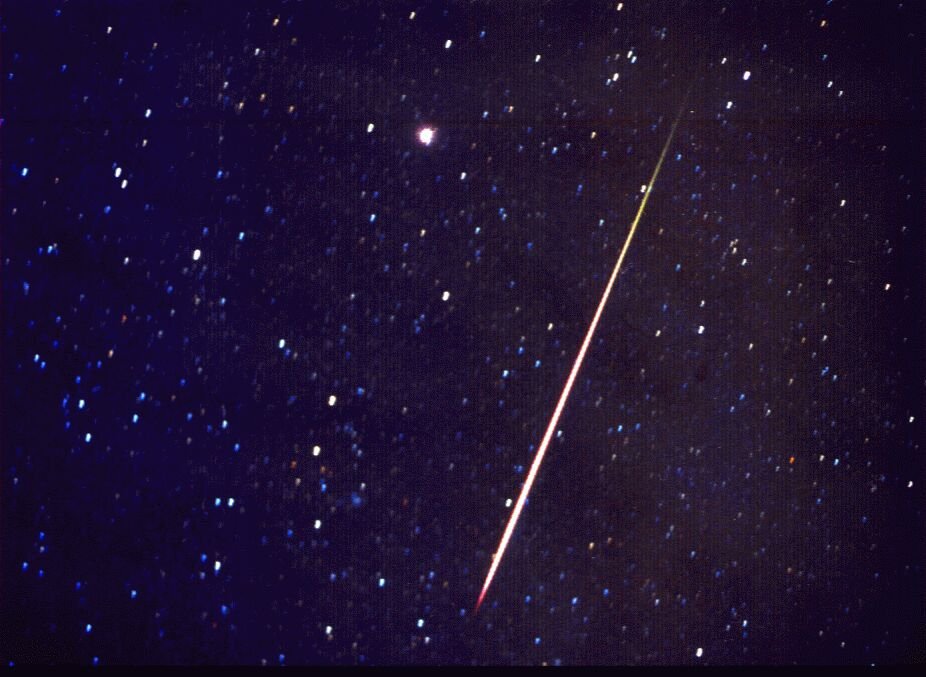
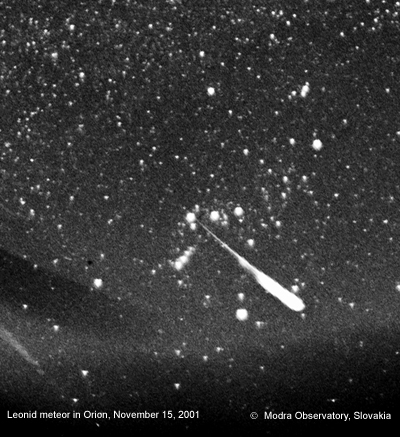
These streaks of light, sometimes called "shooting stars", are the trails of particles entering the Earth's atmosphere from outerspace. Most bright meteors are about the size of a pea. They hit the Earth's atmosphere at very high velocities, more than 50 km/s (108,000 mph!). At this high speed the friction with our atmosphere vaporizes the small rock particle, causing it to get hot, to glow, and this creates the flash of light we see. There are three terms when talking about meteors that you should know. A meteor that has not yet entered the atmosphere (sitting in its orbit around the Sun) is called a meteoroid. While it is passing through the atmosphere it is called a meteor, and if it hits the surface it is called a meteorite. What do they look like? Here is one common type, an "iron" meteorite (because it is mostly made of iron!):
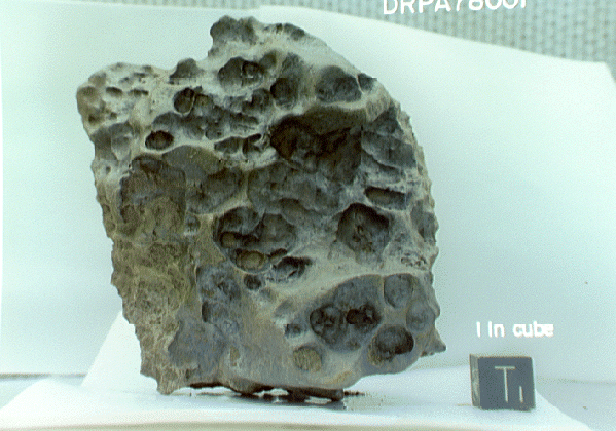
The surface of a meteorite has a crust from the high temperatures it endured on its way to the Earth's surface. The interiors of meteors can be quite complex, with a range of structures. For some pictures of slices through meteorites go to page 375 of the text (Fig. 13.8). We can date the ages of meteors and find that most of them are about 4.5 billion years old. One clue to the age of the solar system!
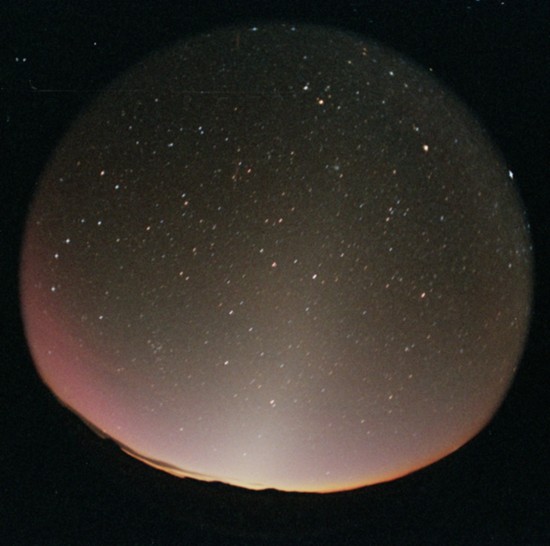
There are also small bits of dust scattered throughout the solar system, and if conditions are perfect (very dark, clear sky and the right orientation of the ecliptic) you can see a faint glow called the zodiacal light shown here: